Introduction
Are you taking days with a brush and roller to paint the walls, fences and ceilings to get the finish you want? Homeowners and amateur painters end up wasting time and effort by having the wrong tools to do the job. A paint sprayer provides more coverage within a shorter time, results are smoother, and the final outcome is more professional on nearly every surface. The professional team of samsimonpainters has professional grade paint sprayer equipment to ensure perfection in every project, whether small or large.
There is still a place in brush and roller painting, but it can never be compared with the speed and consistency of a good painingt sprayer on large or complex surfaces. In this guide, you will be able to make a smarter decision when it comes to your next painting project by covering the eight key situations in which a painting sprayer will outperform traditional tools. Visit our professional spray painting services to learn how the right equipment delivers results each time.
What Is a Paint Sprayer and How Does It Work?
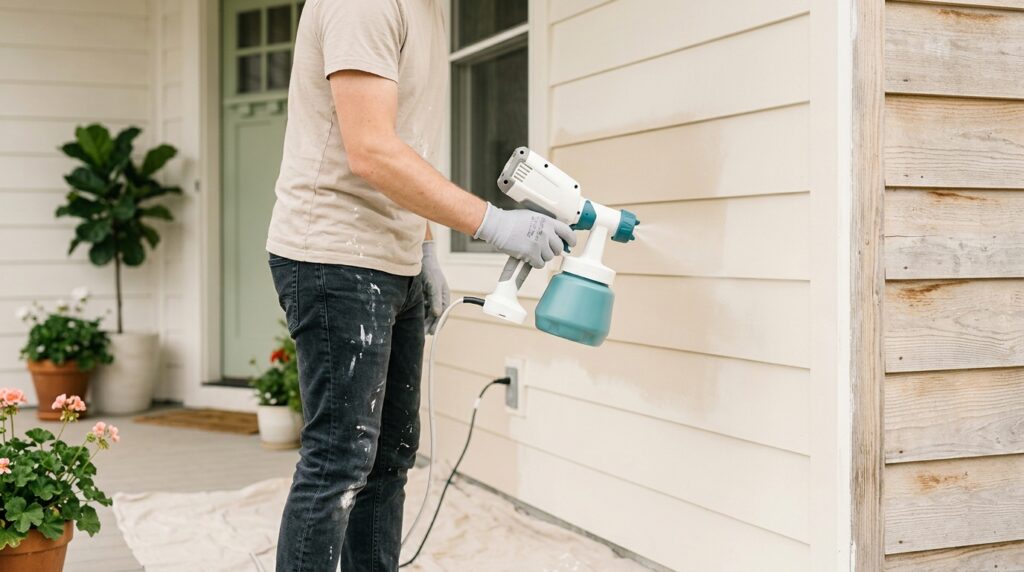
A paint sprayer is a device which atomises a liquid paint into a fine spray and applies it as evenly to surfaces as it can. It will also provide a more uniform, smooth coating than brushes and rollers, making it the tool of choice when it comes to large areas of coverage and detailed finishes. Knowing the working of a paint sprayer assists you in selecting the appropriate type of paint sprayer to meet your project needs.
There are various formats of modern painting sprayers: air-powered, airless, electric, and cordless, each type being used in different applications and environments. The fundamental principle consists of taking paint out of a container, pressurising it and then discharging it at a controlled rate through a nozzle. The initial step in the process of attaining a professional finish is to select the right type of sprayer to use on the surface and paint product you are working with.
Types of Paint Sprayers Explained
- Air painting sprayer – This is a paint sprayer which uses compressed air to spray paint on fine finishes and detailed work.
- Airless painting sprayers – apply hydraulic pressure to push paint through the nozzle with no air present.
- Electric painting sprayer – uses electricity to give a steady output and easy handling of the sprayer inside the home.
- Cordless sprayer paint – battery-powered to be as portable as possible and as flexible as possible outdoors.
Key Benefits of Using a Paint Sprayer
- Higher coverage rate -coat high areas in a fraction of the time.
- Smoother finish – no brush marks or roller texture on the final finish.
- Consistency of application – uniform layer of thickness of coating in all places.
- Versatility – can be used on walls, ceilings, fences, furniture and exteriors.
Airless Paint Sprayers vs Traditional Painting Methods
Airless paint sprayers use high-pressure hydraulic force to push paint through a small nozzle tip, creating a fine, even spray without compressed air. They are the industry standard on large residential and commercial painting project in which speed and consistency are very important. Airless painting sprayers require much less time than brush and roller and have a much better finish.
The conventional brush and roller techniques are slow, labour intensive and tend to produce visible texture on the finished surfaces. Although they perform well in small touch-ups and detail areas, they do not perform as well as airless painting sprayers in large flat areas. In any project occupying more than a small room, a sprayer will in virtually any case yield a superior result.
Advantages of Airless Paint Sprayers
- High-pressure use – thick paints, stains, and primers, without thinning.
- Even, smooth coating – eradicates roller marks and brush strokes.
- More expedited project completion – includes large spaces up to four times faster than rolling.
- Applicable on any surface – walls, ceilings, exteriors, fences, and timber all respond well.
When Brush and Roller Are Still Useful
Brush and roller would still be the correct choice where small areas of detail, tight corners, and complex trim work where spray control is challenging. Even cutting in around window frames, door edges, and skirting boards still needs a fine brush to cut in. An intelligent solution is to have a sprayer with high efficiency on large areas and a brush with high accuracy on fine finishing work.
Electric Paint Sprayer and Cordless Sprayer Paint Options
An electric paint sprayer is directly powered to a power outlet which provides a constant pressure and reliable output when it comes to an interior or exterior painting project. It is less difficult to manage than a compressed air system and needs less technical expertise to be effectively managed. One of the most popular items among the homeowners and professional painters is the electric painting sprayer that offers a balance between the power and simplicity.
Going a notch higher than the convenience of electric sprayers, the cordless sprayer paint systems ensure the absence of the power cable altogether. Outdoors, remote locations, and jobs where it is unrealistic to run a power cord. Battery-powered cordless units are the perfect tool in these situations. Both electric and cordless sprayer paints have been improved significantly in the past few years to be considered truly competitive with more professional-grade equipment.
Benefits of Electric Paint Sprayers
- User friendly- simple installation and uniform pressure delivery.
- Repeat spray pattern – predictable quality of coating throughout the process.
- Low maintenance – easier internal operation than compressed air systems.
- Appropriate in the majority of paints – works with both water-based and light oil-based paints.
Cordless Sprayer Paint – Flexibility and Convenience
Cordless sprayer paint system has unparalleled portability, hence the best tool to use in painting fences, garden structures and outdoor furniture. Painters can easily and efficiently cover a large area of the outdoors since they are not restricted by a power cord. The current battery technology implies that the cordless units are now long-lasting to the extent that they can be charged once, and work long enough to complete entire residential projects, often on a single charge.
8 Situations Where a Paint Sprayer Is Better Than Brush and Roller
The following are the eight cases, where it is obvious that a paint sprayer is the better tool to use in the job. Whether it is interior walls, outside fences, or commercial buildings, the paint sprayer can fit practically any painting project and is more efficient than the traditional methods.
Large Wall Painting Projects
Large interior and exterior walls are covered by a paint sprayer in a fraction of the time that a roller would need, a smoother and more even finish being achieved. It does away with the tiredness of using frequent roller strokes on broad surfaces. The only tool which can render the job really manageable is a sprayer, which is necessary in rooms with high ceilings or in open-plan living areas.
Fence and Outdoor Surface Painting
A fence painting sprayer is used to apply paint to pickets, palings and rails in a single pass, covering a surface that would have taken hours with a brush. The spray enters crevices and surfaces that are irregular and rollers and brushes never reach them. In timber, Colorbond or treated pine fences, a fence paint sprayer will provide a complete, consistent coat each time.
Painting Ceilings and High Areas
Spraying ceilings means that the physical labor of rolling overhead and again and again is eliminated as well as the resulting physical strain on the roller is also removed. A paint sprayer with an adjustable nozzle is able to reach high spots with minimum effort and no visible lap lines. In high commercial or residential ceiling spaces, the only feasible method is spray application.
Furniture and Cabinets Finishing
Fine finish work on furniture, cabinetry and joinery demands the type of smooth, even finish that only a paint sprayer can be counted on to provide. Any brush marks and roller texture are entirely removed and furniture has an appearance of factory quality. This renders spray application to be the most preferable process when it comes to repaints of kitchen cabinets and furniture restoration projects.
Exterior House Painting
Exterior building works have large diverse surfaces; render, weatherboard, brick, and cladding; which react unusually well to spray application. Paint sprayer is used to paint the whole exterior of a house in a day when brush and roller would take several days. Even, too, the surface texture is penetrated more deeply by the even coat, enhancing the appearance and durability.
Commercial Painting Jobs
Big business spaces – warehouses, offices, retail stores, and industrial buildings – require the tool to be scaleable without compromising on quality. A professional paint sprayer is able to manage commercial size quantities of paint easily, keeping projects on schedule and on budget. Spray equipment is the main tool of commercial painters, used in almost all large-scale applications.
Detailed Surface Coating
The application of fine mist sprays should be used as a decorative finish, textured finish, or as an elaborate architectural detail that cannot be coated evenly using a brush. A paint sprayer is used to provide a uniform coating to cut timber, ornate cornices and detailed metalwork without accretion or drips. This degree of accuracy cannot be reproduced using a normal brush or roller.
Repainting Large Properties
Repainting a whole property -the interior and the exterior- is a huge task that requires the highest efficiency of all the tools employed. The overall amount of hours needed is dramatically reduced by a paint sprayer and allows the project to be completed with a lot less fatigue and disruption. In the case of investment properties, rental turnovers, and pre-sale renovations, there is only one realistic option, i.e. staying on time and on budget, though spray painting is the only option.
Fence Paint Sprayer – Best Tool for Outdoor Painting
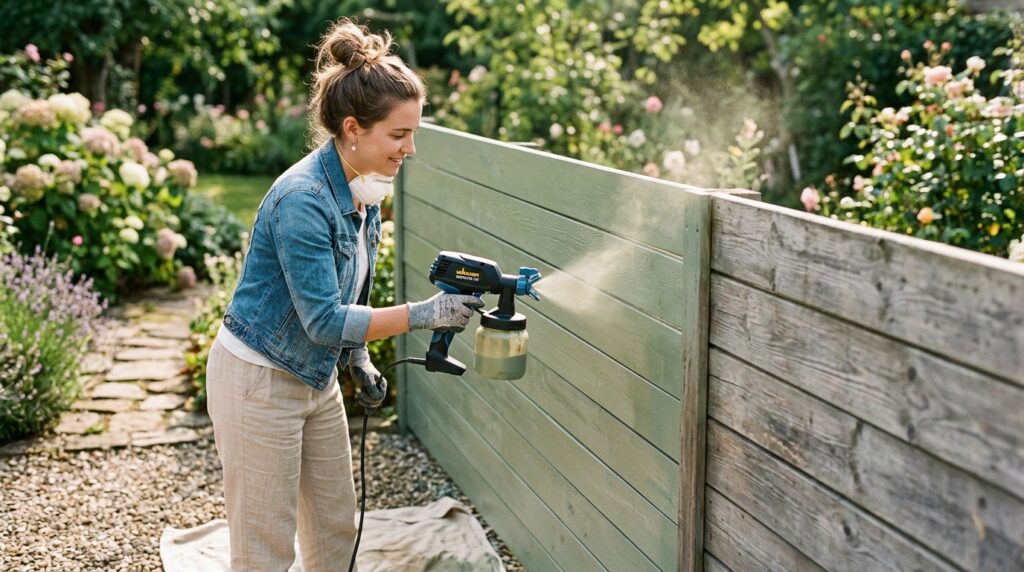
The most effective tool can be used to paint timber, steel, Colorbond and treated pine fences in a short period of time and at a uniform pace. One of the most time-consuming painting jobs that a homeowner can encounter is the application of the brush on a lengthy fence. Giving up a full-day project to a job that can be accomplished in a few hours is achieved by switching to a fence paintin sprayer.
The spray nozzle will cover all angles of surfaces, grooves and gaps of a fence panel that a brush would take many strokes to cover. This leads to a more complete coverage, a much better penetration of paint and a much more uniform finish over the entire length of the fence. To the home owners of Melbourne that have long boundary fences, a fence paint sprayer is just the smarter, faster and more professional tool.
Why Use a Paint Sprayer for Fences(Expert Insight from samsimonpainters)
Samsimonpainters encourages the use of spray application on all fence painting projects since it is fast and has better coverage than can be achieved by manual application. The team has professional fence painting sprayer equipment to use to cover whole residential fences in one session with a clean, even finish. All projects are able to enjoy the accuracy and uniformity of professional spray equipment.
Best Techniques for Fence Spray Painting
Clean and prepare the fence surface – clean it off, remove loose paint and debris.
and cover garden beds, paths and other adjoining structures with drop sheets.
Adjust the proper spray distance -usually, between 25 and 30 centimetres of the surface.
Make horizontal strokes with smooth, even strokes that overlap each other.
Coat twice to obtain complete coverage and leave ample time between coats to allow complete drying.
Air Paint Sprayer – Understanding Basic Spray Systems
The air paint sprayer emits compressed air through a hose tip that atomises the paint into a fine, controllable mist at the sprayer tip. It is an old and most established spray painting technology, which is extensively utilized in automobile, furniture, and detailed finishing applications. One of the best patterns of spray that can be produced using the air painting sprayer is a high-quality decorative finish on the project.
Oversprays are the primary trade-off in an air painting sprayer, since the amount of air is large, and thus a greater number of paint particles miss the target surface than with airless systems. This renders masking and preparation more significant when air-based systems are utilized in closed or detailed settings. Nevertheless, this drawback does not affect the fine finish quality of an air paint sprayer; it is unsurpassed in some specialist applications.
How Air Paint Sprayers Work
An air paint sprayer is connected to a compressor which provides a constant flow of pressurised air through the gun body. A cup or reservoir is filled with paint, and a fine atomised mist is created by mixing the air stream with paint at the nozzle. The spray pattern, fan width and paint volume are controlled by adjustable dials on the gun body.
Pros and Cons of Air Painting Sprayers
Quality of fine finish – creates the most refined, high quality surface texture possible.
Adjustable control – accurate pattern and volume settings of fans to give finer work.
Increased overspray – greater amount of waste paint than airless or electric.
Adds cost and assembly time to any project that requires compressor – addition of extra equipment presents a cost and a time in which to assemble that extra equipment to the project.
Frequently Asked Questions
What is a paint sprayer used for?
A paint sprayer is applied to paint a large area or detailed area with a fine spray in order to apply paint evenly with a fine spray.
Is a paint sprayer better than a roller?
Yes, in large areas and smooth finishes, sprayer is quicker and more effective to use than roller.
What are airless painting sprayers used for?
They are applied to paint on large surfaces under high pressure such as painting walls, fences, exteriors.
Which paint sprayer is the best one to be used at home?
Electric painting sprayer is in most cases the most convenient to use in DIY home projects.
Is it possible to use a fence painting sprayer to work on outdoor projects?
Yes, it is perfect in fences, decks, and other outdoor constructions.
What are the differences between air and airless painting sprayers?
Compressed air is used by air sprayers, and a high pressure is used by airless sprayers to achieve thicker coatings.
Are electric painting sprayers user-friendly?
Yes, they are user-friendly and offer reliable outcomes.
What is a cordless sprayer paint system?
It is a battery-powered, portable sprayer that provides flexibility to outdoor and remote work.
Is more paint wasted by paint sprayers?
They are capable of producing overspray, although with the correct technique, wastage may be reduced to a minimum.
Will I contract professionals to do the spray painting?
Yes, professionals ensure better finish quality, efficiency, and long-lasting results.
Conclusion
One of the most useful tools that any homeowner, renovator, or professional painter can have at any time to achieve quick, smooth, and consistent results is a quality paint sprayer. Be it airless painting sprayers to use on large scale projects, an electric painting sprayer to do work indoors or a cordless sprayer paint system just in case you need to work outdoors, the right paint sprayer makes every job faster and better. Being able to know what type fits your particular project is the difference between a frustrating experience and a truly professional finnish.
Do not accept slow and bumpy performance in situations where the appropriate tool can be used to totally transform your project. Contact the reliable service of the samsimonpainters, to get expert advice and professional spray painting services that give perfect results throughout Melbourne. And now that you have learned how to select and apply the appropriate paint sprayer to each job, are you now ready to achieve a finish that will look indeed professional? Get Your Free Quote with Samsimonpainters Today →